 Samy Lazraq
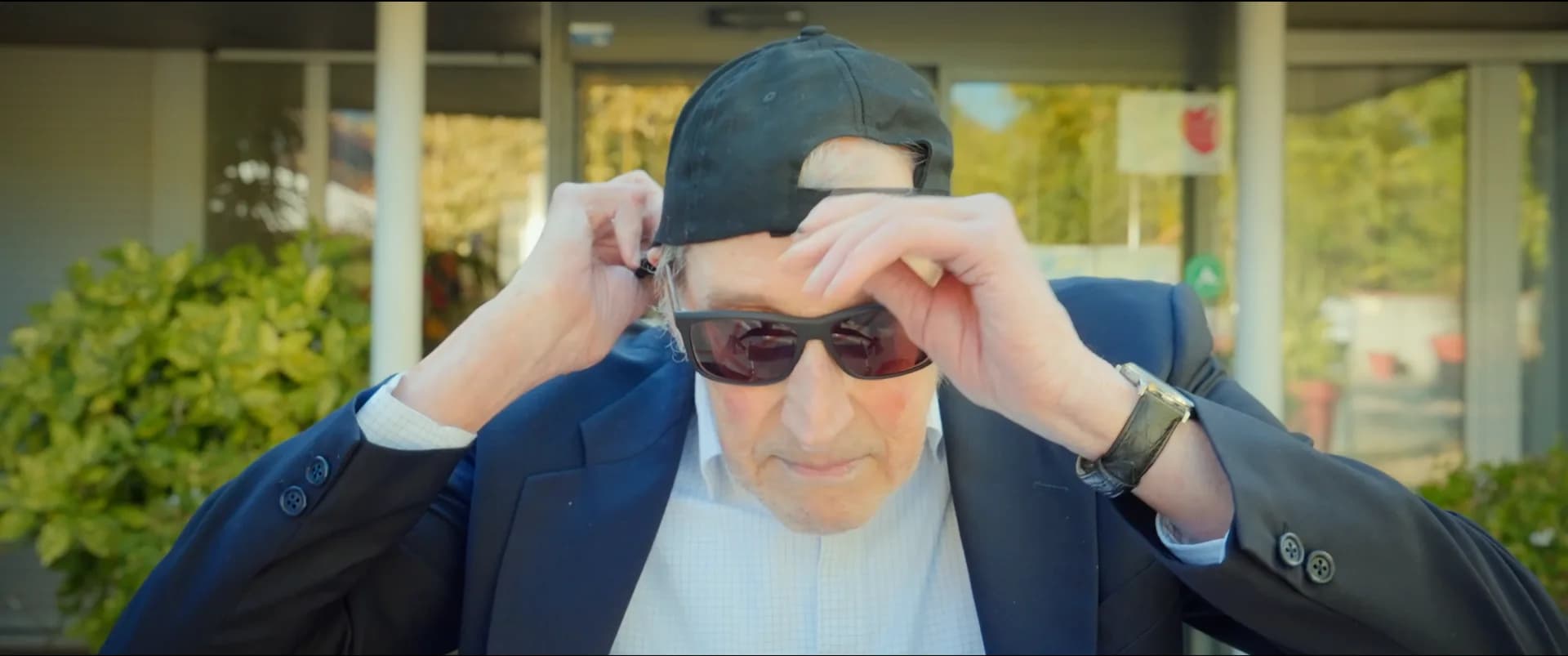
‘A resident turns his cap backwards.’
That line wasn't written by a director. It comes from the creative brief the Tiers Temps residence in Blagnac sent us on 2 September 2026. Fifty-six days later, a resident turned his cap round in front of our camera. It's at the 42nd second of the film.
In between: a script, four versions of a production file, 29 numbered shots, a flight declaration for a populated area and a signed agreement to paint a wall. That's what making a corporate video means. Guides on the subject give you a list of steps. We'd rather open a real file, with its dates, and also show you what changed between paper and screen.
How to make a corporate video: the seven steps
A corporate video is made in seven steps: the creative brief, the script, the shot list, the permissions, the shooting schedule, the shoot and the edit. The first five happen before a camera is switched on, and they take the most time. For the Tiers Temps residence film, near Toulouse, 67 days passed between the quote and delivery: 59 days before the first shot, two days of shooting, then six days to delivery.
- 28 August: the quote.
- 2 September: the creative brief, written by the residence.
- 14 September: our film proposal, with the script.
- 24 September: the advance declaration for drone flights over a populated area.
- 6 October: the mural sketch, received from the artist.
- 15 October: the fourth version of the production file, and the agreement for the wall.
- 26 and 28 October: the shoot.
- 3 November: delivery.
A simpler film moves much faster. An interview at your premises needs no drone, no wall and no children. But the order stays the same, because whatever isn't decided on paper gets decided on set, while everyone is waiting.
The creative brief: the client writes it better than we do
A creative brief says what the film should tell, to whom, and in what tone. It says nothing about cameras or budget. Many businesses think it's the production company's job. Our best example proves otherwise.
The Tiers Temps brief runs to five pages. It opens with a refusal: to avoid ‘entirely the usual codes of the care home corporate film’. It takes a stand on old age, then sets a trap: at first, the viewer ‘thinks they know where they are and what they're going to see’. And it imagines the turn:
A resident turns his cap backwards. Another takes the brake off his walking frame. A resident lowers the screen of his laptop. Another puts on his sunglasses.
Creative brief from the Tiers Temps Blagnac residence, 2 September 2026.
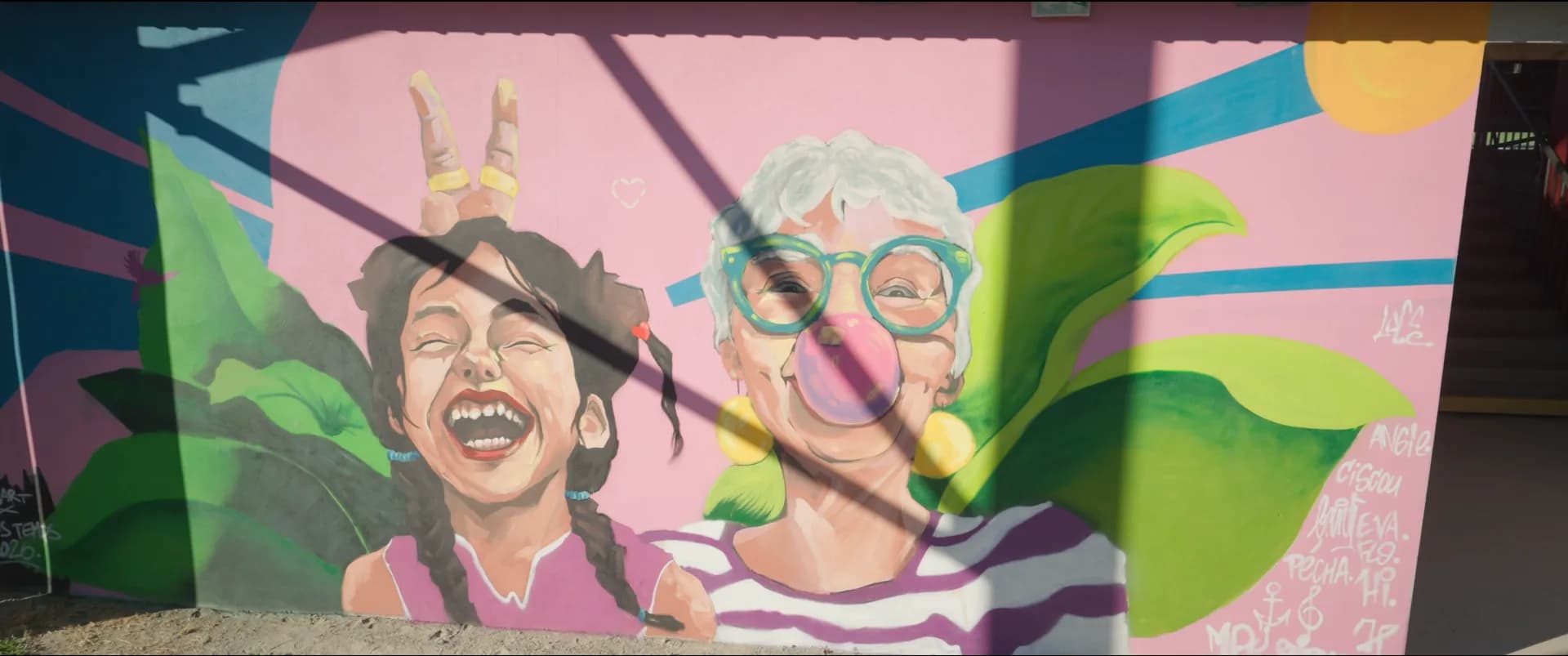
Watch the film: the cap, the walking frame, the laptop and the sunglasses are all there. The mural was already there too, described as an ‘elderly person making bunny ears behind a child's head’. That's what the artist Lucce painted on the wall of the Stade Argelès.
Don't like writing? Answer these four questions, in order. That's already a creative brief.
- What should the viewer think at the end of the film? For Tiers Temps: growing old doesn't stop you being an engaged citizen, curious and funny.
- What won't you show? For Tiers Temps: elderly people ‘trying to look young’.
- Where will the film be watched? A website, LinkedIn and a reception screen don't call for the same length or the same format.
- Which film do you wish you'd made? Send a link: it's more precise than any description.
The script: 60 seconds in three movements
On 14 September, we replied with a seven-page film proposal. The script comes down to three movements: complicity, adventure, pride. A confession to camera, the group setting off, then words on a black screen and a smile.
It adds what the brief couldn't give: an opening line, ‘Today… we go over the wall’, and the sound of a spray can heard from the very start, without knowing where it's coming from. The can only appears halfway through the film. That's a script's job: giving the viewer a reason to stay. The film's title comes from there. The two closing lines and the sign-off, ‘Passionnément vivant.’ (passionately alive), were already in the residence's brief: we didn't touch them.
The shot list: 29 shots for 60 seconds
The shot list turns the script into a list of shots: for each one, the location, the action, the shot size, the camera movement, the sound and the duration. Ours has 29 lines. Here are five, exactly as written in the 15 October file:
- Shot 1, residence, bedroom or lounge. The resident looks into the camera and shares his secret, with a half-smile. Close-up at eye level, static. Direct speech, spray can sound off screen. 3 seconds.
- Shot 10, dining room. A cup is set down. The music stops. Tight shot, static. 1 second.
- Shot 14, entrance hall. A wheel starts turning. Detail shot at ground level, tracking. Hip-hop. 1 second.
- Shot 17, Stade Argelès wall. A spray can is shaken: the sound from the opening finally makes sense. Close-up, static. 1 second.
- Shot 25, wall. The camera pulls back and reveals the whole work with the group. Wide shot, tracking back. 4 seconds.
One second on screen takes far more than one second on location. The file says so at the foot of the page: ‘Every shot is filmed longer than its final duration, and from several angles for action shots.’ And this is the stage where you can still change everything, for the price of rewriting a line. Ours went through four versions before the shoot.
Permissions: what the edit can't fix
A bad shot can be replaced. A face filmed without consent can't. For this corporate video, the file listed:
- Image rights for adults: a form for every person filmed, whether resident, staff member or contributor, also signed by the legal representative where a protection order requires it.
- Image rights for children: written consent from the parents.
- The location: the artist's consent and an agreement for use of the wall.
- The drone: Blagnac lies under the control zone of Toulouse-Blagnac airport. It took an advance declaration for flying over a populated area, a file for each of the three zones flown over, and notifying the gendarmerie the day before each flight. We cover this on our drone filming in Toulouse page.
- Credits: the names of participants and partners, to gather before the edit.
The file ends with a page to sign, the shoot approval: ‘You approve the script, the shot list and the call sheet. Any change after approval may push back the shoot or the edit.’ It tells everyone that the last moment to change their mind is now.
The shooting schedule doesn't follow the order of the film
The shooting schedule puts shots in the order they can be filmed, not the order they'll be seen. It depends on locations, light and people's availability. On our film, shots 2 to 4 were filmed two days before shot 1.
- Monday 26 October: drone and exteriors, without the residents. Parc des Ramiers, Vieux Blagnac, the church square, the area around the residence.
- Wednesday 28, 9 am: the residence, for the confession, the morning and the departure.
- Wednesday 28, afternoon: the Stade Argelès wall, with the children and Lucce.
- Wednesday 28, 5 pm: the mural is finished, we film its reveal. Wrap by 6 pm at the latest.
Look at Monday: no residents. Nobody came out for shots that didn't need anyone. And look at Wednesday at 5 pm: the last image of the wall depends on a mural painted that same day. If it runs late, there's an hour to spare.
Shooting schedule and call sheet: what's the difference?
The shooting schedule sets the timetable for the whole film. The call sheet covers the day: who comes, where, at what time, and what to prepare. It's the document that tells your team what's expected of them. Ours asked for:
- one resident to open and close the film, chosen on the day from the participants;
- three or four residents for the departure and the mural;
- a nurse, the breakfast service and the staff accompanying the outing;
- the children and Lucce, at the wall;
- a point of contact at the residence, Caroline Noor, project manager.
Remember that last line. Without someone who knows the place and the people, a shoot on business premises loses its hours in the corridors.
The shoot and the edit: what changed along the way
A production file isn't there so you film exactly what's written. It's there so you know what you're changing, and why. Between the 15 October paperwork and the 3 November film, here's what moved:
- The opening line. Written: ‘Today… we go over the wall.’ On screen: ‘Today, we're going over the wall.’
- The setting for shot 1. Planned in a bedroom or lounge. It was filmed outdoors.
- The cap. In the residence's brief, but in neither our script nor our shot list. It came back during the shoot, and we made it the image for this article.
- The cup. Written at the 20th second, before ‘Right. Shall we go?’. In the edit, it lands at the 38th, just after.
- The length. 60 seconds on paper, 1 minute 43 delivered, credits included.
Because everything else was nailed down, there was room to watch what was happening in front of the camera.
Six days separate the end of the shoot from delivery. The film went out as several files: 4K, HD, a lighter version for the web and a version for LinkedIn. Ask for these versions at the quote stage, because it's easier to frame for a format during the shoot than to rescue it in the edit.
The edit was quick, and our exchanges smooth and efficient.
Caroline Noor, for Tiers Temps Blagnac, in a Google review.
How long and how much for a corporate video?
When there's a script, permissions and several locations, think in weeks: just over nine for Tiers Temps, from quote to delivery.
A scripted film is priced on a quote, because its price depends on what you've just read: the number of locations, people, versions and permissions. We work at fixed day rates, and our plans are on request:
- Signature, for small businesses, startups and professional firms: two half-days, one 90 to 120-second video, 15 retouched photos, motion design and cinema-grade colour grading.
- Premium, for mid-sized and large companies: a full shooting day, 4K aerial footage, one or two videos cut into several formats, 30 photos, scriptwriting and storyboard, sound design and mixing.
Several shooting days add up in a single quote, and commercial rights are assigned on delivery. For a market benchmark, Slot B, in Toulouse, quotes €2,000 to €4,000 for a company presentation film, and Studio FLF up to €15,000 excl. VAT for a corporate film. We break these costs down in our article on the price of a corporate video.
Capturit, video production agency near Toulouse
Capturit writes, shoots and edits corporate films from Castanet-Tolosan, just south-east of Toulouse, and from Perpignan, where the company was born, both in the South of France. We also build websites, so your film doesn't end up forgotten in a shared folder. In June 2026, we also filmed and edited videos for an American company in Cannes.
To get started, we need one page from you, or a call if you'd rather talk than write. The script, the shot list, the permissions and the shooting schedule are our job. The cap, we'll leave to you.
Plan your corporate video
Watch the full film and the story of the project, then our video production agency in Toulouse page. Send us your creative brief, even if it's three lines: we'll come back to you with a quote.